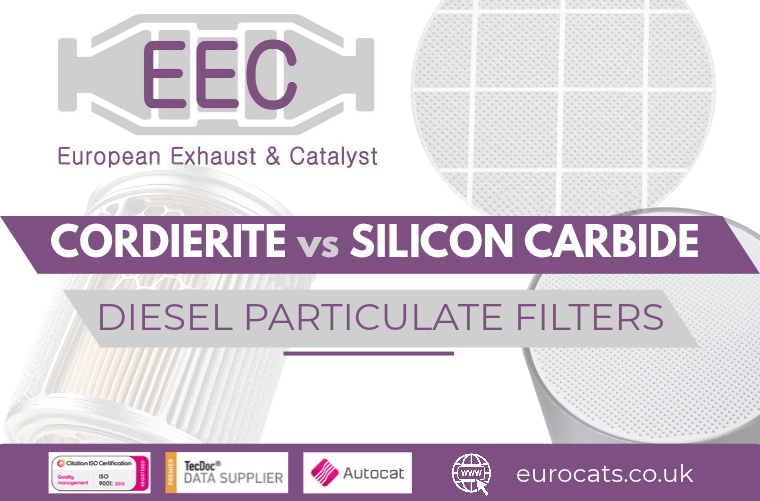
Diesel Particulate Filters (DPFS) are a key part of modern diesel emissions systems, designed to capture soot and particulate matter from exhaust gases.
However, not all DPFS are manufactured using the same substrate material.
Cordierite and Silicon Carbide (SiC) are two of the most commonly used ceramic materials in DPF construction. While both are designed to provide effective particulate filtration, their different properties mean they perform differently under varying thermal conditions.
EEC looks at the key differences between the two.
Cordierite DPFS
Cost effective, lightweight and effective
Cordierite is a ceramic material widely used in passenger cars and light-duty diesel applications.
One of its main advantages is its relatively low manufacturing cost, combined with a lightweight structure and good filtration efficiency.
Key characteristics of Cordierite include:
- Excellent filtration efficiency
- Relatively lightweight
- Generally lower manufacturing cost
- Lower thermal conductivity
- Suitable for normal regeneration cycles
- Good thermal performance under normal operating conditions
However, Cordierite has a lower temperature capability and lower resistance to thermal shock than Silicon Carbide.
Why does this matter?
During DPF regeneration, temperatures within the filter can rise significantly as accumulated soot is burned away.
If regeneration temperatures become excessively high, for example, as a result of an underlying engine or emissions system fault there is an increased risk of damage to the substrate.
This makes correct diagnosis particularly important when dealing with DPF-related faults. Simply replacing the filter without addressing the underlying cause could result in the replacement DPF experiencing the same problem.
Silicon Carbide (SiC) DPFS
High-temperature resistance and durability
Silicon Carbide is another ceramic material commonly used for DPF substrates. Its properties make it particularly suitable for applications where the filter may experience higher thermal loads.
Key characteristics of SiC include:
- Excellent filtration efficiency
- Very high temperature resistance
- Excellent thermal shock resistance
- Higher thermal conductivity
- Good durability under demanding conditions
- Better suited to higher-temperature regeneration
- Generally higher manufacturing cost
- Typically heavier than Cordierite
Why is SiC more resistant to heat?
One of the key differences between the two materials is their ability to deal with heat.
Silicon Carbide has a high temperature capability, combined with high thermal conductivity and excellent thermal shock resistance.
This allows it to better tolerate the rapid temperature changes that can occur during DPF regeneration.
For applications where higher thermal loads are expected, these characteristics can make SiC a suitable substrate material.
Cordierite vs Silicon Carbide: What’s the difference?
| Characteristic |
Cordierite |
Silicon Carbide (SiC) |
| Material |
Ceramic |
Silicon Carbide ceramic |
| Filtration |
Excellent |
Excellent |
| Heat resistance |
Good |
Excellent |
| Thermal shock resistance |
Good |
Very high |
| Thermal conductivity |
Lower |
Higher |
| Regeneration |
Normal operating conditions |
Higher-temperature applications |
| Weight |
Generally lighter |
Generally heavier |
| Cost |
Generally lower |
Generally higher |
| Typical applications |
Passenger cars / light-duty vehicles |
Applications with higher thermal loads |
Is one better than the other?
There isn’t a simple answer.
Both materials can provide excellent filtration performance, but their different characteristics make them suitable for different applications and operating conditions.
When diagnosing a DPF problem, technicians should consider more than just the condition of the filter itself.
Soot loading, regeneration temperatures, engine performance and the wider emissions system can all be relevant when identifying the root cause of a failure.
A damaged DPF may be the result of an underlying fault rather than the original cause of the problem.
The importance of correct diagnosis
Understanding the differences between DPF substrate materials can help technicians recognise how a filter is designed to operate and why excessive temperatures can be a concern.
Whether a vehicle is fitted with a Cordierite or Silicon Carbide DPF, correct diagnosis and addressing the underlying cause of a DPF fault are essential to help ensure the replacement component performs as intended.
For more information visit and EECs full product range please visit the EEC website www.eurocats.co.uk


 Back to all