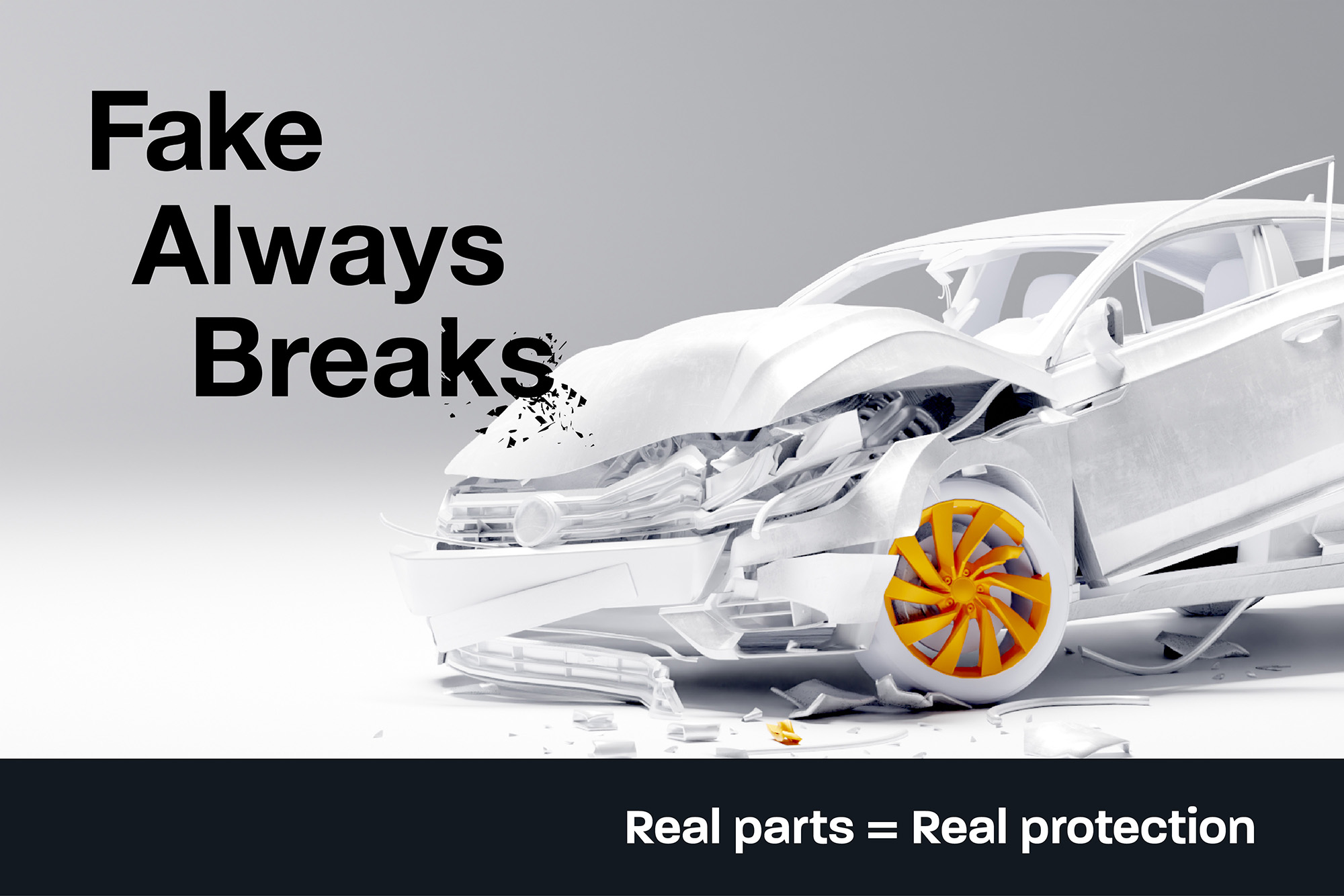
The Intellectual Property Office’s (IPO) has launched its latest counterfeit vehicle parts awareness and safety campaign, ‘Fake Always Breaks’.
The IAAF has been involved in the increasing issue of illegitimate and fake matching quality replacement parts. In particular, there is a growing issue of counterfeit parts, as well as parts which require to be type approved, but although being marked and sold as being type approved, when tested were clearly not to the required specifications.
These parts should be of a good quality, as well as fitting and working correctly, but this is often not the case. The issue of selling products fraudulently, as well as the issue of warranty should the fake product not fit or work correctly, creates significant problems for both the workshop and the customer.
The key issue is ensuring that only legitimate, quality replacement parts are sold and fitted to customer’s vehicles.
In support of this, the IAAF is working with its members and the UK’s market surveillance unit to provide evidence of counterfeit products, as well as the revision of its Code of Conduct to help support its members to identify and supply only legitimate products.
Fake or sub-standard vehicle parts are often cheap-looking imitations, but it can sometimes be hard to tell the difference between a fake and genuine product. Such fake parts are usually made from inferior materials and are not safety-tested, increasing the risk of failure. This can have serious consequences to drivers, passengers, and other road users.
It can be difficult for consumers to identify fake car parts, including commonly counterfeited components like brake pads and discs, spark plugs and filters. In this market where technology is constantly improving vehicles, particularly the safety aspects, criminals use advanced techniques to make the parts and packaging look genuine. Just looking at the part might not be enough to identify a fake part but remember, fake always breaks so be vigilant when replacing automotive components.





 Back to all