More than 300 million car, light commercial vehicle and truck tyres are changed every year in Europe to replace worn or defective tyres, about 45 million of them in Germany alone. The majority of car drivers and many commercial enterprises still leave a lot of potential savings for the environment and mobility costs untapped. With professional system solutions for the repair and retreading of tyres for passenger cars and trucks as well as industrial, agricultural and off-the-road vehicles, REMA TIP TOP, based in Poing near Munich, is promoting a sustainable tyre cycle that reduces costs and raw material consumption.
“Retreading worn tyres and repairing defective tyres is an ecologically and financially unparalleled alternative to new tyres,” says Gerhard Hieber. He is Product Manager at REMA TIP TOP, a network partner of Allianz Zukunft Reifen (AZuR, translates as Alliance for the Future of Tyres). As one of the world’s leading manufacturers of tyre repair systems, REMA TIP TOP supports the AZuR network’s long-term goal of reusing or recycling 100 percent of tyres after their first use cycle. Education and training in the field of tyre repair also play an important role. For this reason, REMA TIP TOP trains companies in the use of various repair systems at the REMA TIP TOP Academy in Poing near Munich.
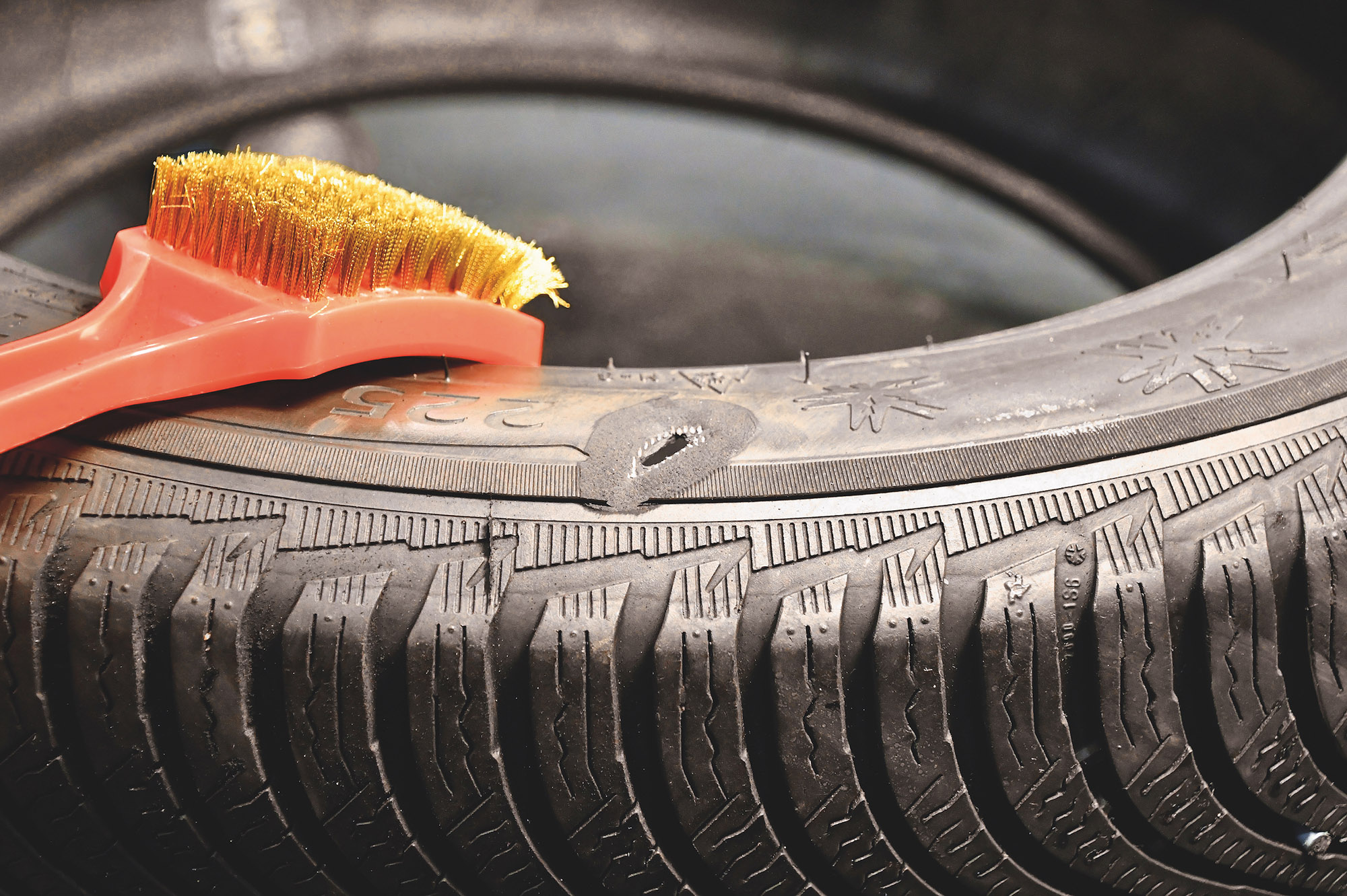
Each year, an estimated four million drivers in Germany experience tyre damage. All it takes is a nail on the road or contact with a curb. Gerhard Hieber assumes that in more than 1.5 million of these cases, a repair is technically possible and also makes economic sense given the expected mileage. And without compromising safety. This includes punctures in the tread or damage to the sidewall.
“Repaired tyres offer the same level of safety as new tyres, even at high speeds and torques. This is ensured if the damage is properly assessed and the repair is carried out in a specialized workshop.” The classic damage patterns with an expansion of 3-6 mm can be repaired quickly and cost-effectively with the TÜV-certified MINICOMBI system, manufactured by REMA TIP TOP in Germany. Hot vulcanization is used for larger punctures up to 10 mm. The resource and cost benefits of tyre repair are significant. Since a defective tyre usually has to be replaced on every axle, new tyres can cost up to €100 or even €200 more, depending on the tyre size and performance class.
Innovations are also providing ever better arguments for tyre repair. As part of its ongoing product development, REMA TIP TOP was the first supplier in the world to launch a tyre repair patch with a bimodal bonding layer, which is characterized by exceptionally high initial adhesion and significantly improved structural strength. In terms of sustainability, there is also an important trend towards solvent-free tyre repair. Tyre repair is positive for the environment anyway. Gerhard Hieber: “According to our calculations, the manufacture and disposal of a tyre produces 44 kg of CO2. In Germany alone, tyre repairs could save over 32,000 tons of CO2 emissions every year.”





 Back to all