Many drivers fit aftermarket devices to their vehicles, often with the best intentions – particularly when it comes to protecting vulnerable road users like cyclists and pedestrians.
But your vehicle must be compliant, otherwise you could face enforcement action.
At DVSA we’ve noticed a worrying increase in non-compliant and illegal light fittings. This includes some Vulnerable Road User (VRU) signs, decorative lights and blue warning beacons.
VRU signs
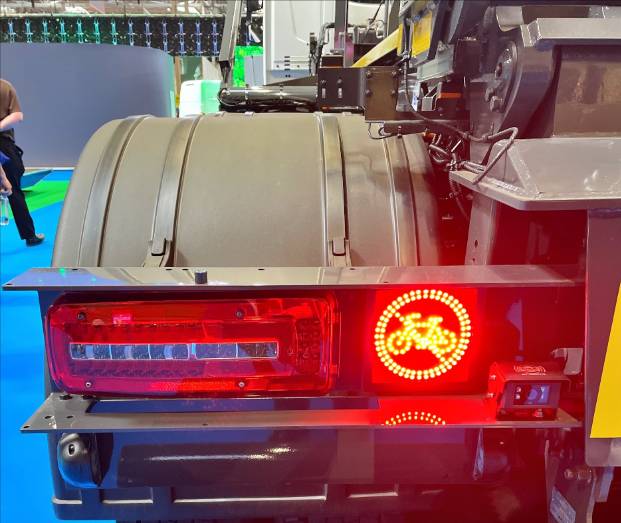
VRU signs are devices you can buy from third-party suppliers and fit onto your vehicle. They are designed to reduce incidents involving cyclists, motorcyclists and pedestrians and your vehicle.
These devices display a visual warning, usually a pictogram or LED lamp, or sound an audible alert. They’re typically fitted to the rear or the side of a vehicle or trailer.
Why VRU signs may not be compliant
VRU signs that work in tandem with your vehicle’s indicators are classed as directional indicators. However, your signs may not be compliant, and it is an offence to use non-compliant lights.
Many devices that operate in conjunction with indicators don’t meet the legal requirements because they:
- emit light of the incorrect colour – the correct colour being amber
- have the wrong flash rate- the correct flash rate is between 60 and 120 times a minute
We recommend operators, manufacturers and installers to stay up to date on our latest guidance regarding compliance.
How to stay compliant
This is not an exhaustive list, but these are examples of the requirements you must meet.
To remain compliant, you should:
- fit devices to the sides and rear of vehicles only
- not position them on side guard rails or rear underrun devices
- not increase the maximum permissible width of the vehicle
- not allow devices to protrude in a way that creates risk or danger to cyclists, pedestrians, and other road users
- use non-reflective materials
You can use the devices:
- when they are operated with the vehicle’s indicators, providing they are amber in colour and flash at the same rate and in unison with the vehicle’s indicators. However, your rear facing lights must be red in colour.
- where the device has an independent system, when the lighting does not flash in sequence with the vehicle’s indicators and emits a continuous light.
Like you, we want to reduce the number of incidents involving vulnerable road users. However, it’s equally important that devices are fitted correctly and meet the necessary requirements.
To help operators, we will issue advisory notices at annual tests (MOT) where we see only ‘technical’ non-compliance of these devices. However, if they are fitted in a way that could be considered clearly dangerous, they will be failed at test. If the vehicle is stopped for a roadside check, other enforcement action may be taken).
For example, a VRU sign emitting a flashing red light when the indicators where operated would typically result in the issue an advisory notice. However, where the device is mounted on to the vehicle sideguard and excessively protrudes, presenting a safety risk, this would result in a test failure.
Decorative LED light displays
We’ve also seen an increasing trend in the use of digital LED light displays on vehicles, including HGVs. These animated displays may, for example, mimic human eyes, display messages or show emojis. In some cases, decorative coloured lights are installed inside the cab of the vehicle, behind the driver. However, these are also visible outside the vehicle and can be distracting for other road users.
Why Decorative LED light display may not be compliant
Digital LED displays fall outside of approved lighting standards. The Department for Transport, DVSA and police forces have raised serious concerns about their use on vehicles on public roads because they:
- distract road users from critical signs, signals and surrounding traffic
- have no legal or universally understood meaning, which can confuse other road users
- could cause dangerous driving behaviour
How to stay compliant
The rules may seem quite complex in this area. We have not tried to explain the lighting regulations fully here, but some simple tips are:
- any light that shows moving images is almost certainly illegal
- any red light facing forwards is also likely to be an offence
Importantly, action can be taken even if the lights are turned off at the time. It really is best not to fit decorative LED lights to your vehicle and it is an offence to have non-compliant lights.
Blue warning beacons
We’re also finding a concerning increase in the number of blue lights being fitted to HGVs as warning beacons. This is something the police will take action on if it’s discovered.
Using blue warning beacons is illegal. Only emergency vehicles are permitted to fit blue warning beacons, special warning lamps, or similar devices.
Blue lights are universally recognised as a signal for emergency vehicles. Installing them on other vehicles is illegal. Anyone caught with them faces a fine and points on their licence and could also be prosecuted.
How to stay compliant
Blue lights must not be fitted to non-emergency vehicles. If your vehicle has blue lights fitted, remove them before using the vehicle on our roads as it is an offence to use a vehicle with non-compliant lights.
Working together on road safety
Road safety remains our priority. We’re committed to working with drivers and operators to make sure vehicles are compliant and safe. This reflects references made in the Road Safety Strategy (January 2026) to strengthen Commercial Vehicle Enforcement.





 Back to all